

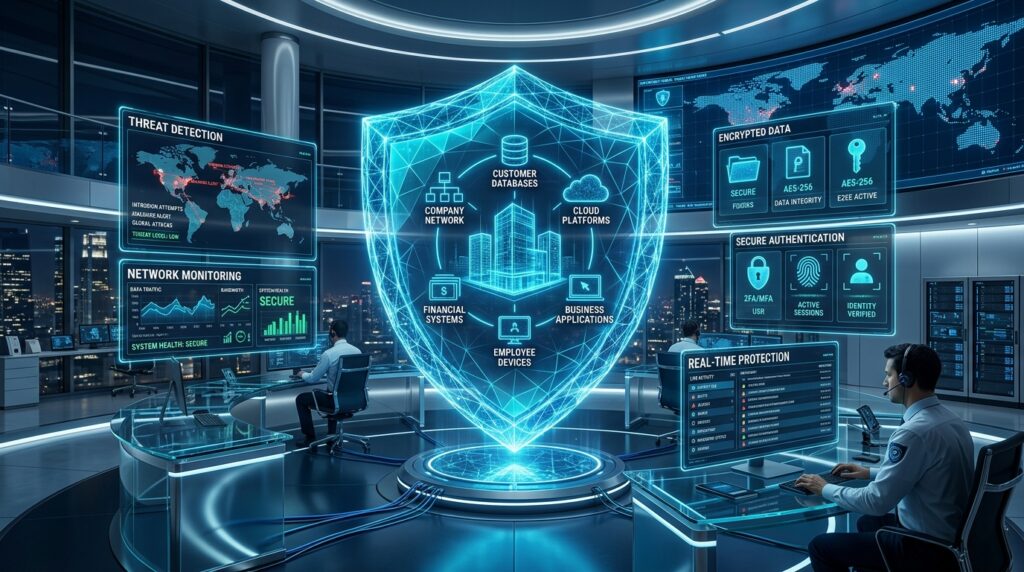
Why Cybersecurity Should Be a Top Priority for Your Business in 202

Cybersecurity is no longer an issue that concerns only large technology companies. Today, businesses of all sizes rely on websites, cloud platforms, email, customer databases, payment systems and digital communication tools to operate.
As businesses become more dependent on technology, protecting digital assets and customer information has become an essential part of responsible business management.
A cybersecurity incident can disrupt operations, expose sensitive information, damage customer trust and result in significant financial losses. For small and growing businesses in particular, a single security weakness can have serious consequences.
Cybersecurity is therefore more than an IT responsibility. It is a business priority that involves leadership, employees, technology, customers and everyday business processes.
In this article, we explore why cybersecurity matters, the common threats businesses face and practical steps you can take to build a stronger security foundation in 2026.
What Is Cybersecurity?
Cybersecurity refers to the practices, technologies and processes used to protect digital systems, networks, devices, applications and information from unauthorised access, disruption, misuse or damage.
For businesses, cybersecurity can include protecting:
- Customer information
- Employee accounts
- Business websites
- Financial records
- Cloud services
- Company devices
- Email accounts
- Business applications
Effective cybersecurity combines technology, policies and responsible human behaviour.
Why Cybersecurity Matters for Your Business
Modern businesses rely heavily on digital systems. A security incident can affect almost every area of an organisation, including:
- Business operations
- Customer relationships
- Revenue
- Brand reputation
- Employee productivity
- Legal and regulatory responsibilities
This makes cybersecurity an important part of business continuity, risk management and customer trust.
Protecting Customer Data
Customers trust businesses with valuable information. Depending on the organisation, this may include contact details, account credentials, purchase information, payment details and communication records.
Protecting this information demonstrates that your business takes customer privacy and security seriously.
Protecting Your Business Reputation
Trust is one of the most valuable assets a business can build.
Customers expect businesses to handle their information responsibly. A serious security incident can damage that trust and cause customers to reconsider whether they want to continue using a service.
Security should therefore be viewed as part of the overall customer experience, not something that happens behind the scenes.
Common Cybersecurity Threats Businesses Face
Understanding common threats is the first step towards protecting your organisation.
1. Phishing
Phishing attacks use deceptive emails, messages or websites to trick people into revealing information, providing login details or clicking malicious links.
Employees should be trained to recognise suspicious messages and verify unexpected requests before taking action.
2. Malware
Malware is malicious software designed to damage systems, steal information or gain unauthorised access.
Keeping operating systems, applications and security tools updated can help reduce exposure to known vulnerabilities.
3. Weak or Reused Passwords
Weak or reused passwords can make business accounts easier to compromise.
Businesses should encourage employees to use strong, unique passwords and enable multi-factor authentication (MFA) wherever possible.
4. Social Engineering
Social engineering involves manipulating people into revealing confidential information or performing actions that compromise security.
This is why employee awareness is such an important part of cybersecurity.
5. Unpatched Software
Outdated software can contain known security weaknesses that attackers may exploit.
Regular updates and security patches can help reduce unnecessary risks.
Employee Cybersecurity Awareness
Technology alone cannot protect a business.
Employees interact with emails, websites, applications, customer information, and company devices every day. One careless action can potentially create an opportunity for an attacker.
Businesses should provide regular cybersecurity awareness training covering:
- Phishing recognition
- Password security
- Multi-factor authentication
- Safe browsing
- Device security
- Data handling
- Suspicious activity reporting
Creating a security-conscious workplace makes cybersecurity part of everyday business behaviour.
Use Strong Authentication
Passwords are an important layer of protection, but businesses should consider additional security measures.
Multi-factor authentication (MFA) requires users to provide more than one form of verification before accessing an account.
This could include:
- A password
- A security code
- An authentication app
- A hardware security key
Adding additional authentication layers can make unauthorised account access more difficult.
Keep Your Software Updated
Software updates often include important security fixes.
Businesses should establish a regular update process for:
- Operating systems
- Websites
- Plugins
- Applications
- Cloud tools
- Security software
Regular maintenance helps reduce the risks associated with known vulnerabilities.
Protect Business Devices
Laptops, smartphones, tablets and other devices can contain valuable business information.
Businesses should consider using protections such as:
- Screen locks
- Device encryption
- Security software
- Automatic updates
- Secure networks
- Appropriate device management
Employees should also avoid using unsecured devices or networks for sensitive business activities whenever possible.
Secure Your Cloud Services
Cloud platforms provide flexibility and scalability, but moving information to the cloud does not automatically make it secure.
Businesses should:
- Use strong authentication
- Review account permissions
- Remove unnecessary access
- Monitor unusual activity
- Keep systems updated
- Understand their cloud provider’s security controls
Access should be based on what employees actually need to perform their roles rather than automatically giving everyone full access.
Back Up Important Business Data
Reliable backups are an important part of business resilience.
If important information is accidentally deleted, corrupted or affected by a cybersecurity incident, secure backups can help businesses recover more quickly.
Businesses should identify their most important information and establish appropriate backup procedures.
Backups should also be protected so unauthorised users cannot easily access, delete or modify them.
Create a Practical Cybersecurity Plan
A cybersecurity plan does not need to be complicated to be useful.
Start by identifying:
- What information needs protection
- Which systems are essential
- Who has access
- Which threats are most relevant
- How security incidents should be reported
- How important data can be recovered
A documented plan gives employees clear guidance about what to do when something goes wrong.
Cybersecurity and Business Continuity
Cybersecurity is closely connected to business continuity.
A security incident could interrupt your:
- Website
- Communication systems
- Payment processing
- Customer service
- Internal operations
Preparing for potential incidents allows businesses to respond more effectively.
A basic incident response plan should identify who is responsible for reporting, investigating, containing and recovering from a security incident.
Building Customer Trust Through Security
Cybersecurity can become a competitive advantage when businesses demonstrate that they take data protection seriously.
Customers are more likely to trust businesses that:
- Communicate clearly about security
- Protect personal information
- Use secure systems
- Respond responsibly to incidents
- Train their employees
- Maintain reliable processes
Security should be part of the customer experience rather than something hidden in the background.
Cybersecurity for Small Businesses
Small businesses sometimes assume they are unlikely to become targets because they have fewer resources than larger organisations.
However, smaller businesses can still hold valuable customer information and may have fewer security resources available to respond to an incident.
A practical cybersecurity foundation should include:
- Strong authentication
- Regular software updates
- Employee training
- Secure backups
- Access controls
- Reliable security tools
- An incident response process
You do not need to implement every advanced security technology immediately. Start with the fundamentals and improve your security practices over time.
Common Cybersecurity Mistakes to Avoid
Even businesses with security measures in place can make avoidable mistakes.
Ignoring Software Updates
Delaying updates can leave known vulnerabilities unaddressed.
Using Shared Accounts
Shared credentials make it difficult to determine who accessed information and can create accountability problems.
Giving Employees Excessive Access
Employees should generally have access only to the systems and information they need to perform their responsibilities.
Neglecting Employee Training
Employees are an important part of your security strategy. Regular training helps them recognise and respond to potential threats.
Treating Cybersecurity as an IT-Only Responsibility
Cybersecurity involves everyone who interacts with company systems and information.
Cybersecurity Best Practices for 2026
Businesses can strengthen their security foundation by adopting practical habits such as:
- Use strong and unique passwords.
- Enable multi-factor authentication.
- Keep software and applications updated.
- Train employees regularly.
- Review user permissions.
- Protect sensitive information.
- Maintain secure backups.
- Monitor important systems.
- Prepare an incident response plan.
- Review security practices regularly.
The goal is to create multiple layers of protection rather than relying on one security measure.
The Future of Business Cybersecurity
Cybersecurity will continue to evolve alongside artificial intelligence, cloud computing, automation, connected devices and remote work.
AI can help organisations identify unusual activity, analyse security events and automate certain defensive processes. However, the same technology can also be used by attackers to create more convincing scams and automate malicious activities.
Businesses will therefore need to combine technology with:
- Employee awareness
- Strong security policies
- Access controls
- Regular training
- Continuous monitoring
- Ongoing improvement
The businesses that prepare proactively will be better positioned to manage emerging threats.
A Simple Cybersecurity Checklist for Your Business
Not sure where to start? Ask yourself:
✓ Are all important accounts protected with MFA?
✓ Are employees trained to recognise phishing?
✓ Is your software regularly updated?
✓ Are important business files backed up securely?
✓ Does every employee have the appropriate level of access?
✓ Are customer details properly protected?
✓ Do you have a plan for responding to a security incident?
✓ When did you last review your cybersecurity practices?
If you answered “no” or “I’m not sure” to several of these questions, it may be time to review your business’s security practices.
Conclusion
Cybersecurity should be a top priority for every modern business because digital security directly affects operations, customer trust, financial stability and long-term growth.
Businesses do not need to implement every advanced security solution immediately. Building a strong foundation through employee awareness, multi-factor authentication, regular software updates, secure backups, access management and clear response procedures is an excellent starting point.
As digital business continues to evolve in 2026, cybersecurity will become increasingly connected to everyday operations.
Businesses that treat security as an ongoing responsibility will be better prepared to protect their data, support their customers and build a trustworthy digital presence.
Your cybersecurity does not have to be perfect to improve. Start with the basics, strengthen your systems and make security part of how your business operates every day.





Responses